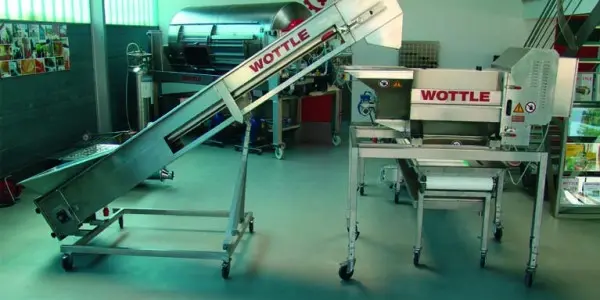
Pre-processing: destemming machines (reblers), sorting systems, crushing units and conveyor belts
Depending on the winery’s philosophy and the method of harvest (hand-picked or machine-harvested), steps may be taken to pre-process the grapes prior to pressing, starting from the moment they are delivered to the receiving trough or the tipping chute. In this process, the grapes can be separated from their stems in the destemmer (also known as a ‘de-stemmer’ or ‘grape separator’) and then cleaned and sorted automatically on a vibrating table or manually on a sorting conveyor before being optimally prepared for pressing in the crushing unit.
WOTTLE’s solutions in these areas are particularly popular with winemakers thanks to their wide range of adjustment options and practical benefits, such as ease of cleaning! Horizontal and vertical loading offer different options for optimally adapting to the spatial conditions in the winery.
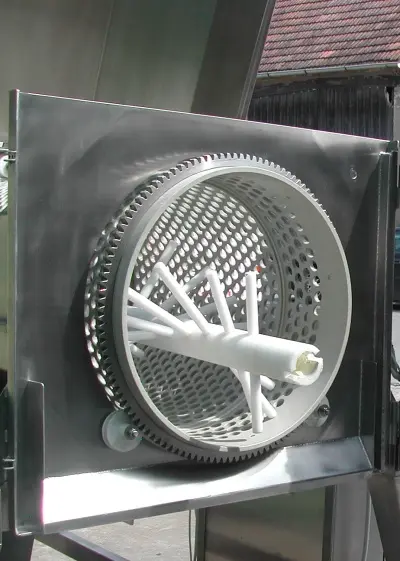
WOTTLE destemming machines: from 5 to 30 tonnes per hour
Ideal destemming for every grape variety and every stage of ripeness: WOTTLE’s destemming machines – ranging from the affordable entry-level model to sophisticated modular machines with a wide variety of adjustment options – offer the right solution for every winery!
Clean separation: from the comb frame to further processing
The aim of the destemming process is to separate the grapes from the stem cluster whilst keeping them as intact as possible. This depends primarily on the rotational speed of the destemming shaft in the basket – and, not least, on the precise control of the volume of grapes fed in via the feed screw. In practice, both factors depend heavily on the crop: the more delicate the grapes are, the more important it is to process them slowly and gently. WOTTLE offers precise adjustment options on its modular machines for this purpose – and, in the basic model, a tried-and-tested solution for smaller wineries.
Technology that aligns with the winery’s philosophy
Whilst the standard A1 machine can only be fed from above (vertically) – ideally in combination with a tilting chute – the A3 and A4 models also offer the option of horizontal integration. In this configuration, the destemming machine is connected directly to the outlet pipe of the receiving trough or the tilting chute via clamping fasteners. With this feeding method, the destemming machine does need to be positioned slightly lower, but the horizontal integration is significantly more space-saving. For cleaning, the clamping connection is simply released and the machine is moved accordingly on its smooth-running castors.
In the standard version (Model A1), the entire machine is driven by a variable-speed motor with a frequency converter and a chain. Adjusting the speed therefore affects the entire destemming process; however, this is entirely sufficient for the typical applications of this model.
In the A3 and A4 berry-separating machines, the berry-separating basket, the berry-separating shaft, the crushing unit and the feed screw are each driven separately and can therefore also be controlled individually. Control is carried out via the central control box, which, in addition to providing access to pre-set programmes, also allows for individual fine-tuning. This allows all processes to be optimally adapted to the condition of the raw material, thereby achieving a correspondingly high standard of processing quality. The feed screw plays a key role in this: it regulates the feed rate of material into the destemming process – so if the condition of the raw material requires the gentlest (slowest) possible destemming, the rotational speed of the screw is simply reduced.
This method can also be used to adjust the counter-rotation of the berry basket and shaft (see next point).
In the modular models, the separate motor controls for the destemming basket and destemming shaft also allow their direction of rotation to be adjusted. This means that destemming is also possible with the shafts rotating in opposite directions. The grapes then fall through the outlets in the basket into either the crushing unit or onto the sorting system, depending on the intended further processing.
Practical benefits
From the A3 model onwards, WOTTLE destemming machines allow the destemming unit (basket and shaft) to be removed in a single simple step, thereby enabling the already destemmed grapes from the machine harvest to be channelled directly to the sorting stage (for removing insects or leaves) or to the crushing unit.
In this way, the winery process can be flexibly adapted to the specific requirements of both manual and machine harvesting.
The simple, tool-free removal of the destemming basket and shaft also plays an important role in cleaning. Both components can therefore be washed quickly and easily. This quick-release design applies to all detachable components, which makes cleaning them considerably easier.
The destemming machine is also designed to be easily accessible from the centre – with a view to saving time on maintenance and preserving the machine’s value, concealed areas have been deliberately avoided.
The WOTTLE destemming basket is made from solid, food-grade PVC, the same material used in water pipework. This material therefore prevents the unwanted leaching of foreign substances. The robust, thick-walled design also facilitates clean destemming, and unlike comparable metal baskets, the soft edges do not damage the grapes. Overall, this results in a better outcome, which in turn forms the basis for high-quality wine.
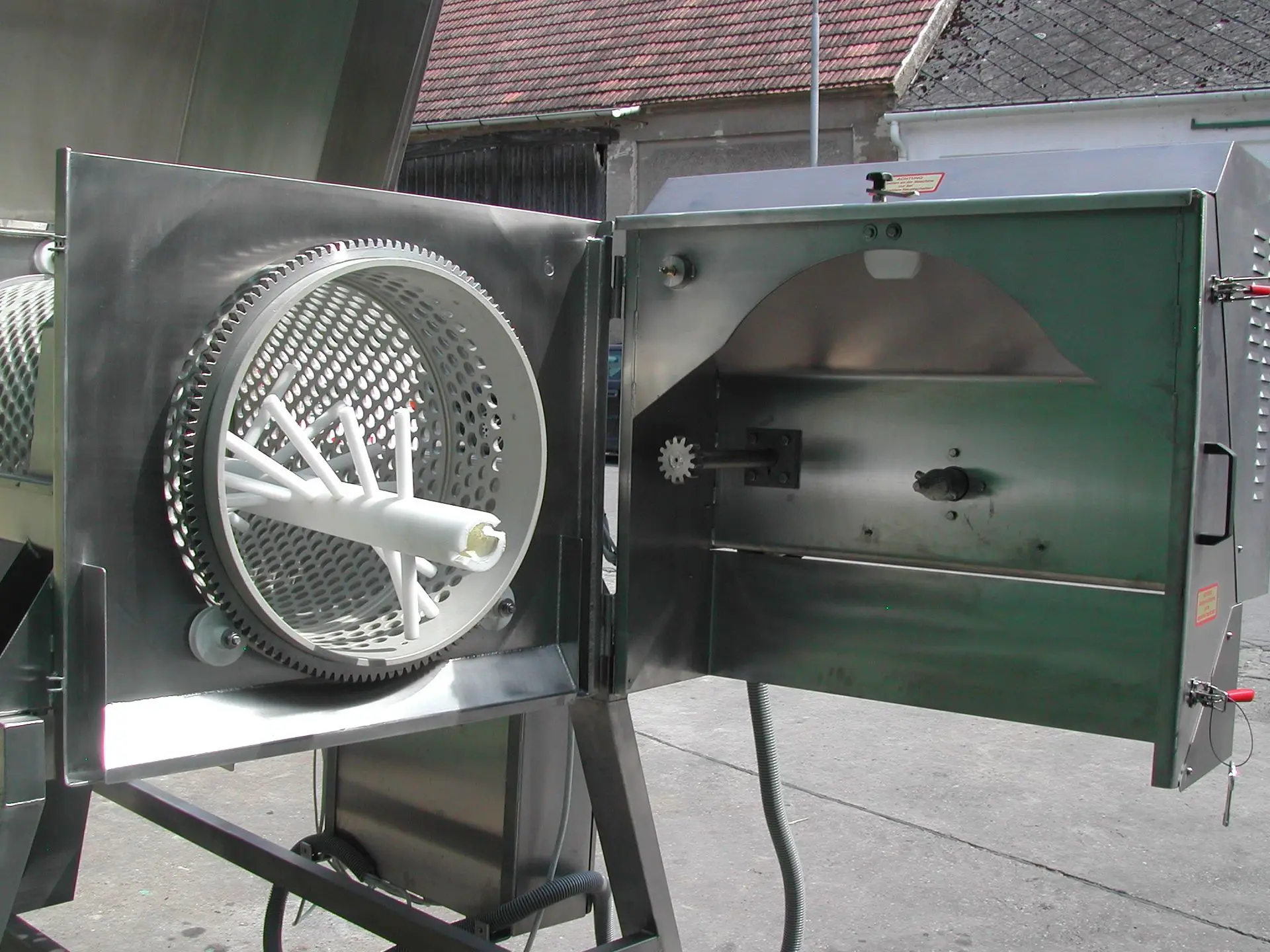
The berry separator and basket can be easily removed for cleaning
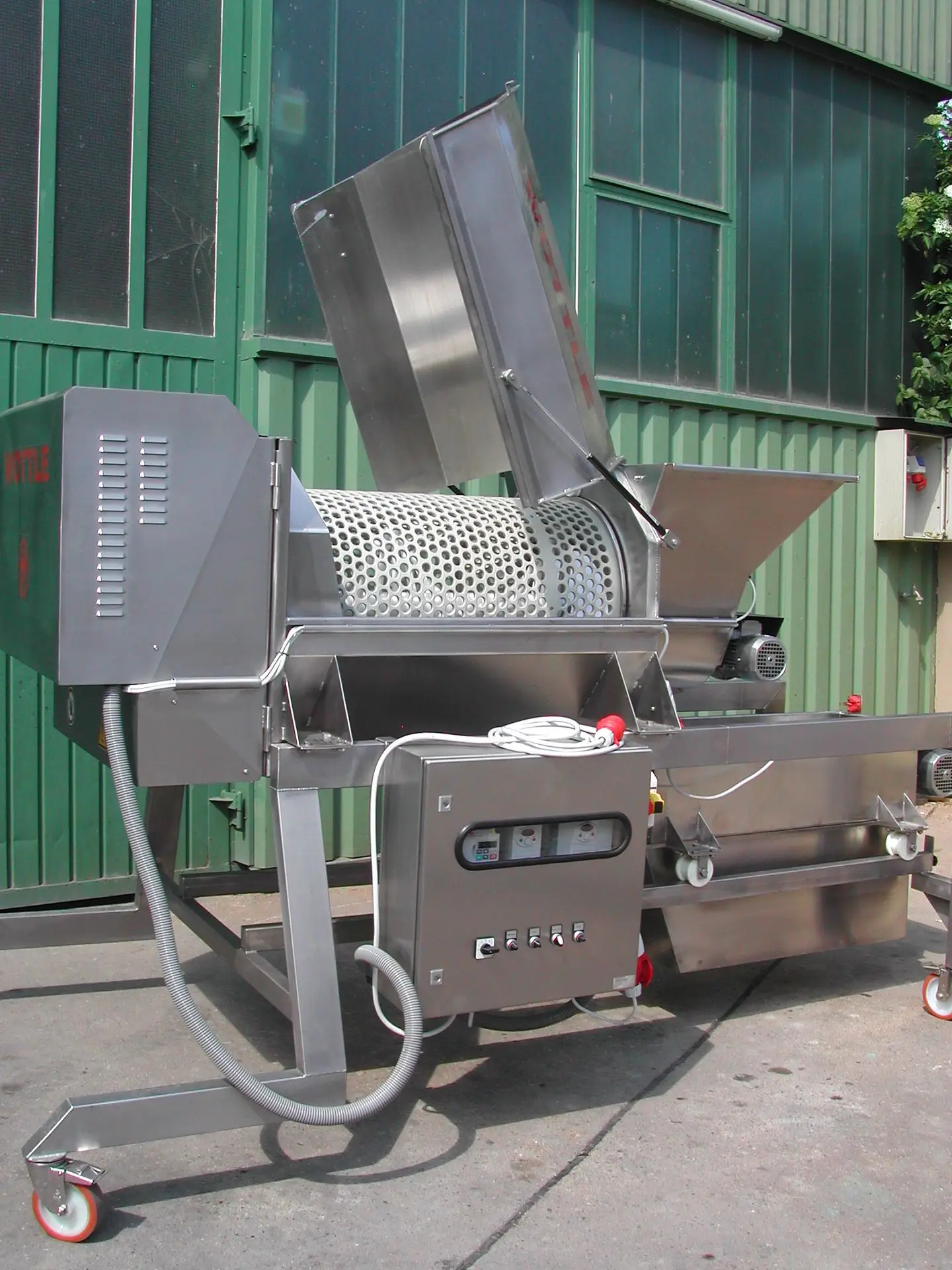
High-quality stainless steel and meticulous craftsmanship
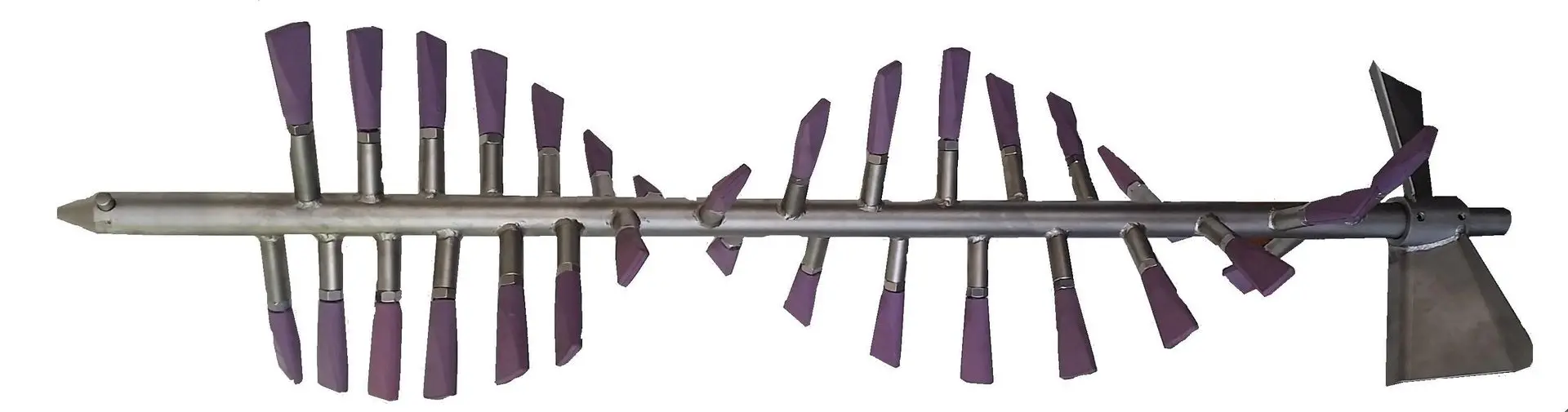
Adjustable speed of the stripping wave (from A3)
WOTTLE sorting systems: sorting conveyors, vibrating tables and roller sorters
Whether done manually or automatically, sorting out insects, unripe grapes or dirt particles is a key part of the winemaking process. WOTTLE offers a range of technical solutions for this – both manual and automatic. Which one is best suited to your needs? Let’s find out together!
Optimised material feed, ideal results
In order to achieve optimal separation of unwanted components during the sorting process, it is important to adjust the volume of grapes fed into the system (e.g. from the destemmer) to match the sorting system’s capacity, thereby preventing the system from becoming overloaded (and consequently producing poor results).
Overview of the technical concepts
The sorting conveyor is the simplest method of sorting grapes. Unripe grapes, stem remnants and other impurities are sorted out manually. Depending on the number of people working at the conveyor, the speed can be continuously adjusted using a drum motor. Furthermore, the feed rate must be adjusted to match the workers’ capacity.
Sorting belts can be custom-made in lengths ranging from 2,000 to 4,000 mm and feature a stainless steel strip on one or both sides to make work easier. The working height can be easily adjusted (up to approx. 1,100 mm) thanks to the adjustable telescopic feet.
The principle behind the vibrating table is relatively simple: the table is slightly inclined, much like a chute, and fitted with side walls; two unbalanced motors provide the necessary vibration. In this way, the grapes are conveyed over the sorting grate; the vibration causes unwanted material to fall away before the grapes are transported, if necessary, via a connected conveyor belt to the crushing unit or directly to the wine press.
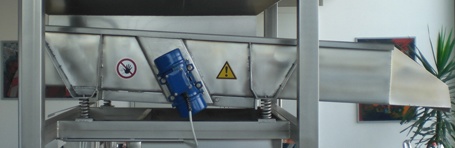
Pictured: a vibrating table with a slight incline and one of the two unbalanced motors (blue) mounted on the side. The technical design involves mounting the table on sturdy steel springs.
The vibrating table is a comparatively cost-effective solution; however, its relatively low processing capacity (max. 5 tonnes per hour) limits its use.
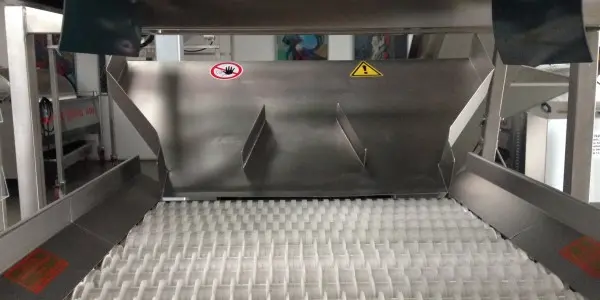
The ROLLY mechanical sorting system has a capacity of up to 15 tonnes per hour, and a vibrating table can optionally be fitted upstream. Leaf residues, stalks and insects are removed. The concave rollers, made from food-grade PVC, are fitted in two configurations: in the first section, their angular cross-section – featuring two different diameters – removes material residues, before the material is guided into lanes in the second section and sorted for the crushing unit depending on the set angle and spacing.
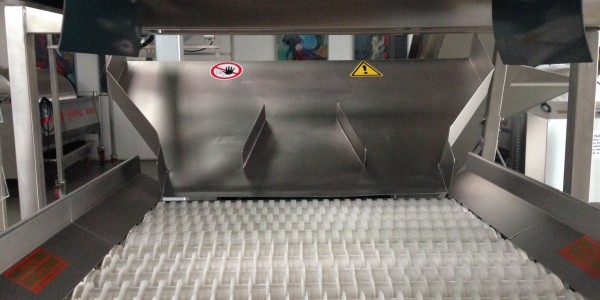
The image shows the angular rollers in the first section in front of the conveyor belts in the second section (further forward in the picture). As the individual concave rollers can be adjusted (in terms of spacing and angle), the system can be adapted to accommodate different berry sizes. The speed can also be adjusted depending on the condition of the grapes.
Any must or juice that may run off can be collected in a drip tray and extracted via a pump connection.
The mechanical roller sorting system operates fully automatically and can be positioned directly beneath the destemming machine and integrated into the control system to ensure optimum coordination.
A key feature of all WOTTLE designs is ease of cleaning, as this has a significant impact on maintaining the machines’ value. The fact that the machines can be dismantled largely without tools and that individual machine parts are easily accessible are therefore practical considerations when choosing a WOTTLE sorting system. These are backed up by compelling arguments regarding labour efficiency and the long-term cost-effectiveness of the investment.
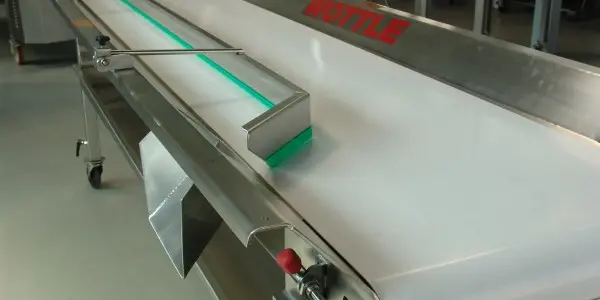
Sorting conveyor belt with a transport system for rejected grapes
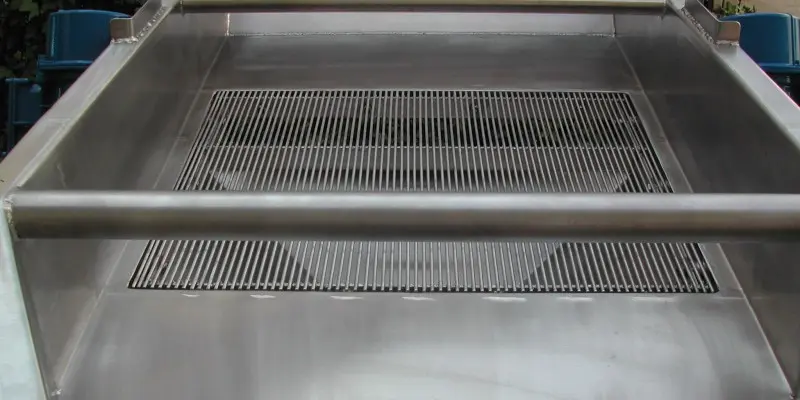
Vibrating table screening grate: capacity up to 5 tonnes per hour
Roll sorting system with a capacity of up to 15 tonnes per hour
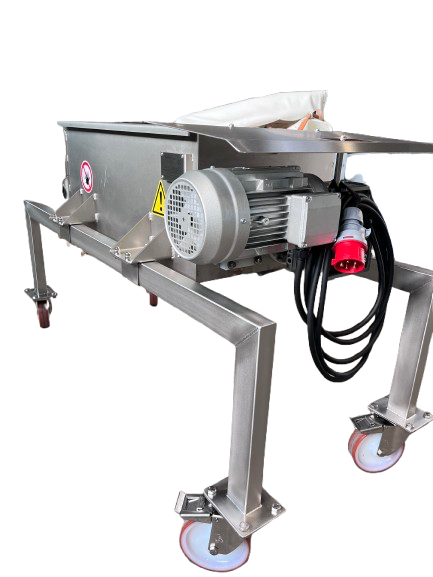
WOTTLE crushing units: ideal preparation of the material to be pressed
Pre-crushing the grapes helps to reduce pressing times and improve the end result. WOTTLE crushing units can be combined with conveyor belts or filled vertically.
In principle, both feeding methods are possible. To achieve this, the rollers of the squeezing unit are installed either lengthways (when fed by a conveyor belt) or crossways (when fed vertically).
A crushing unit is fitted with cloverleaf rollers (diameter 142 or 180 mm) – these rollers owe their name to the shape of their cross-section. The grapes are crushed to varying degrees depending on the distance between the rollers, making it easier for the press to process the grapes. After the crushing process, the grapes can be transported further by means of a positive displacement pump.
WOTTLE crushing units are available with capacities ranging from 6 to 30 tonnes per hour and with motors ranging from 0.55 to 3.0 kW. In the version with its own frame and base, crushing units can be positioned directly beneath the destemming machine (please note the performance profile!). Alternatively, WOTTLE conveyor belts with an integrated crushing unit are also available.
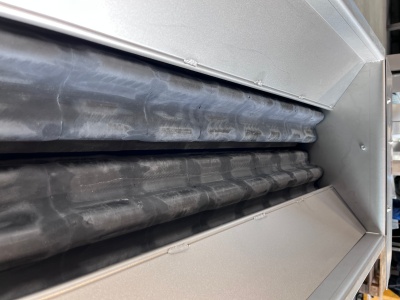
Shown in the picture: rollers with a cloverleaf cross-section for crushing the grapes
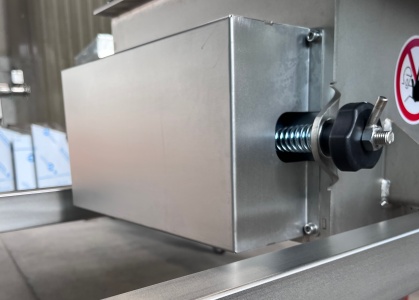
Easy adjustment of the distance between the crushing rollers and, consequently, the degree of crushing
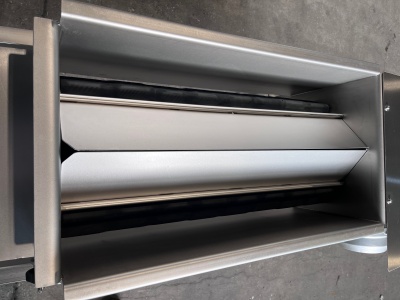
Raised metal panel for easier cleaning behind the rollers and grape transport without crushing
Conveyor belts from WOTTLE: Rethinking the details
With conveyor belts in particular, optimal cleaning is essential to prevent the pressed material being transported from developing a vinegary odour due to oxidation. The design of a WOTTLE conveyor belt is therefore entirely focused on hygiene.
Conveyor belts: greater efficiency in processing
Conveyor belts are the ideal link between different processing units. In many wineries, they are used to feed grapes into the press (from the destemmer or directly from the receiving trough); in red wine production facilities, conveyor belts are often used to transport the must from the red wine fermentation tank to the press.
Hygiene-based design: practical benefits
WOTTLE therefore always takes practical application into account during the design phase: cleaning plays a correspondingly important role here. To ensure easy access to the food-grade belt, WOTTLE therefore designs its conveyor belts with an open structure. Hose connections are located on the underside to enable efficient and time-saving cleaning of the underside of the belt and the rollers. Both the drive roller and the idler roller are fitted with a quick-release mechanism. Releasing the tension makes the conveyor belt easier to clean and ensures that the rollers are accessible from all sides. The conveyor belt can then be returned to operational mode with minimal effort by simply re-tensioning it.
This means that WOTTLE conveyor belts can be cleaned with unrivalled speed and thoroughness.Durch das Umlaufen des Bandes kommen Materialrückstände und Saft auch in den Innenbereich. Das ist nicht nur aus Hygienegründen problematisch: Durch die Oxidation entsteht ein Essigstich, der sich in weiterer Folge auch auf das Pressgut übertragen kann!
WOTTLE therefore always takes practical application into account during the design phase: cleaning plays a correspondingly important role here. To ensure easy access to the food-grade belt, WOTTLE therefore designs its conveyor belts with an open structure. Hose connections are located on the underside to enable efficient and time-saving cleaning of the underside of the belt and the rollers. Both the drive roller and the idler roller are fitted with a quick-release mechanism. Releasing the tension makes the conveyor belt easier to clean and ensures that the rollers are accessible from all sides. The conveyor belt can then be returned to operational mode with minimal effort by simply re-tensioning it.
So sind WOTTLE Transportbänder unvergleichlich schnell und gründlich zu reinigen!
The feed hopper is fitted with a drainage sieve and a juice container beneath it, so that any juice leaking from the grapes is collected before it reaches the conveyor belt. Similarly, the must that leaks out during transport flows through the sieve into the container. From there, the juice can be pumped directly into the tank via a ball valve positioned on the side.
WOTTLE offers maximum customisation even for conveyor belts. Customers can choose between conveyor belts with a width of 400 or 600 mm – other widths are also available, and lengths range from 2 to 10 metres.
Inclines of up to 45 degrees are possible; depending on the material to be conveyed, the conveyor belt can be fitted with higher ribs or cups to cope with steeper angles. Here, WOTTLE also benefits from its experience in designing conveyor belts for the food industry, amongst others.
- Widths: 400 and 600 mm (other sizes available on request)
- Length: 2 m to 10 m
- Inclines: up to 45 degrees as standard (greater angles with belt adaptations)
- Areas of application: Wineries, food industry
Advantages of a WOTTLE conveyor belt
WOTTLE is the only manufacturer to equip its conveyor belts with its own internal cleaning system. The quick-release mechanism on both rollers and the drive roller’s drum motor are also unique features that make WOTTLE conveyor belts particularly efficient during operation.
The food-grade plastic belt is set in motion by the drive roller. Like the idler roller, this is coated with food-grade rubber, which improves the drive, extends the service life and optimises the belt’s movement. The side guides also keep the belt on its intended path.
WOTTLE conveyor belts have also proven their worth in the food industry, amongst other sectors! Depending on the nature of the material to be conveyed (e.g. small items, liquids) and the required incline, the belt is custom-made accordingly (e.g. with greater web height, different driver shapes, cups, pockets, etc.). This means that inclines of over 45 degrees can be overcome and conveying solutions implemented for a wide variety of materials!
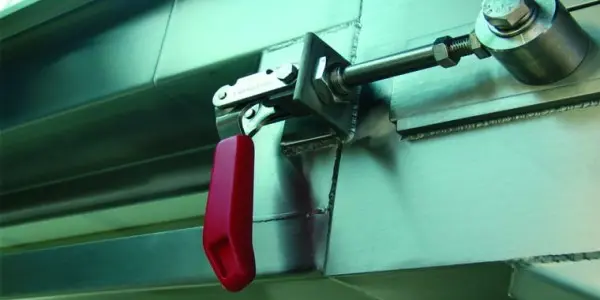
Quick-release fasteners for particularly easy cleaning
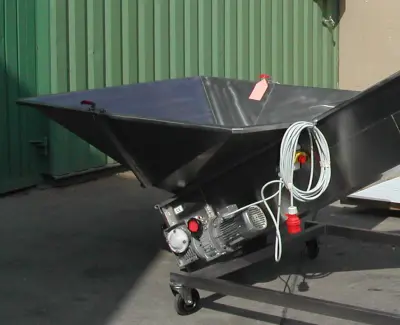
Feed hoppers are available individually