Grape reception: reception chutes and tilting chutes
Depending on the volume to be processed or delivered, receiving troughs or tipping chutes are recommended. Both types must be adapted to the winery’s requirements in terms of both size and technical specifications to ensure that operations run smoothly. Poorly designed grape reception systems lead to problems in subsequent processing stages (such as the destemmer or vibrating table) or compromise the quality of the end product.
WOTTLE therefore offers both transfer systems with a wide range of options for fine-tuning. A common feature of both solutions is the freely mounted screw conveyor, as this design offers the advantages of reduced susceptibility to blockages and easier cleaning during operation. As key system components, the screw conveyor and its drive can be optimally tailored to the required output, quality standards and other operating conditions for both transfer troughs and tipping chutes.
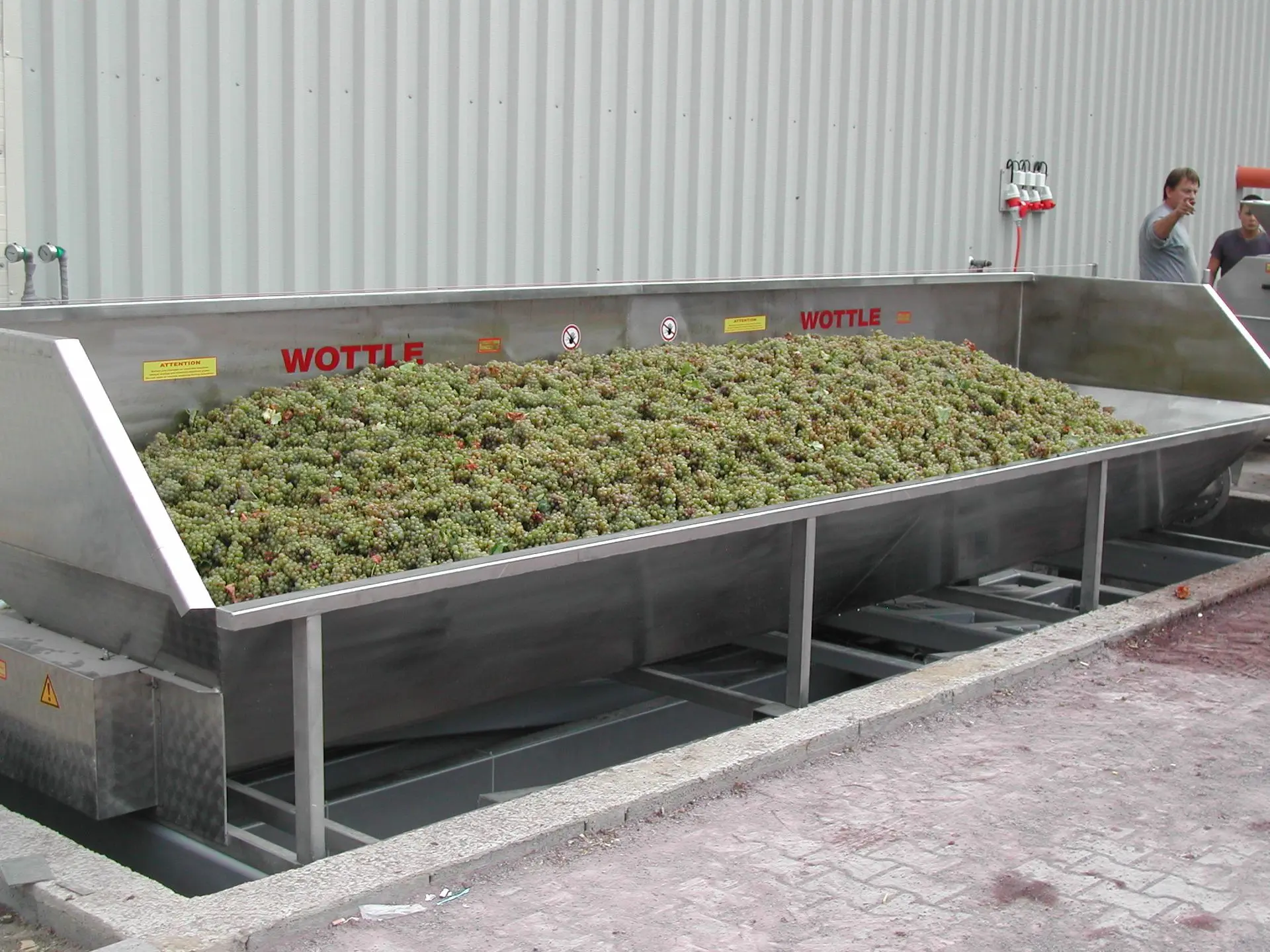
WOTTLE intake troughs: perfectly sized and technically fine-tuned
With lengths of up to 6 metres and a capacity of 3.6 tonnes, WOTTLE transfer troughs come in sizes to suit every requirement! Depending on local conditions, a gear motor can be fitted as a direct drive or with a chain. Worm gears are available in diameters ranging from 250 mm to 350 mm. And that’s not all!
Wine Cellar: What matters when it comes to the new receiving vat
What needs to be taken into account to ensure that the receiving trough becomes the perfect starting point for winery operations? Which features of the WOTTLE receiving troughs for the grape harvest ensure the best possible integration with downstream machinery for pre-processing (destemmer, vibrating table and sorting systems)? We would be happy to analyse your specific winery requirements at your premises!
Screw conveyor: Essential for the optimal transport of grapes
The screw conveyor is used to transport the grapes from the receiving trough to the next stage of the processing chain (e.g. to the destemming unit, the vibrating table for cleaning, the crushing unit or the press). The required dimensions of the screw conveyor depend on various factors:
- elevation differences to be overcome
- Quantity of grapes or capacity of the receiving trough
- Quality standards for the wine, grape variety
- maximum processing capacity of downstream machines
As a general rule, the grapes should be transported as gently as possible to prevent the excessive formation of tannins. Transporting them slowly via the screw conveyor is helpful in this regard. This requires the conveyor to be of sufficient size: if the diameter is too small, the screw conveyor must run faster to transport the grapes. WOTTLE therefore offers screw conveyors in sizes of 250 mm, 300 mm and 350 mm.
The rotation speed can be adjusted either mechanically (via a lever or rotary control) or electronically via a central winery control system, in order to match the transport rate to downstream equipment (e.g. the maximum processing capacity of the vibrating table). The speed also controls the gentleness with which the grapes are handled, so that transport can be optimised for different grape varieties and the condition of the harvested crop.
Unlike securing the screw conveyor to the base of the receiving trough with a round metal plate, free-standing mounting on polyamide belts offers advantages in practical operation. On the one hand, the grapes are transported more gently and without blockages, as there is no longer any potential obstruction caused by the mounting plate. On the other hand, the fact that the screw conveyor is fully accessible along its entire length makes cleaning easier.
Ways to ensure optimal integration into the winery’s workflow
If the receiving trough is situated below the ground level of the winery, a lifting system may be installed to ensure the gentlest possible transport. More cost-effective alternatives include conveyor belts and pumps.
The optional integrated weighing system proves particularly useful for checking delivery quantities, especially when receiving purchased grapes. WOTTLE also offers calibrated weighing systems, although the standard weighing function, accurate to 10 kg, is generally sufficient in practice. All measurement results can be digitally recorded for subsequent verification (depending on the circumstances, either within the winery’s own system or in the WOTTLE Cloud).
To optimise the process, particularly for mechanical harvesting, WOTTLE transfer troughs can be fitted with their own sieve base, which creates a juice tray underneath. The juice tray is accessible from the outside via a ball valve, so that the juice dripping off during transfer can be easily pumped into the appropriate tank for straining.
General features and benefits
Drive: Depending on the on-site installation conditions, the screw conveyor can be fitted with a chain drive (requiring more space) or a direct drive via a gear motor. Motors of appropriate power are selected depending on the capacity (1.5 to 5 tonnes or 6 to 12 tonnes).
Door valve: The door valve, which controls the flow of juice, can be opened and closed using a lever or an electric spindle motor.
Pipe section with access hatch: A separate pipe section can be welded onto the auger inlet area to provide better protection. The access hatch provides the necessary access.
As a general rule, WOTTLE manufactures its transfer troughs to order. The following dimensions, with capacities ranging from 1.5 to 12 tonnes, have proved particularly practical:
- Width 1,500 mm, front loading height 680 mm, optional lengths 2,500 mm (1.5 tonnes), 3,000 mm (1.8 tonnes), 4,000 mm (2.5 tonnes), 5,000 mm (3 tonnes), 6,000 mm (3.6 tonnes)
- Width 2,000 mm, front loading height 1,100 mm, optional lengths 2,500 mm (2.5 tonnes), 3,000 mm (3 tonnes), 4,000 mm (4 tonnes), 5,000 mm (5 tonnes), 6,000 mm (6 tonnes)
- Width 2,500 mm, front loading height 1,250 mm, length 6,000 mm (8 tonnes)
- Width 3,450 mm, front loading height 1,500 mm, length 6,000 mm (10 tonnes)
- Width 3,450 mm, front loading height 1,600 mm, length 6,000 mm (12 tonnes)
Recognising the high stresses to which the material is subjected, WOTTLE transfer troughs are manufactured to be particularly robust. Continuous welded seams, a clean finish and a sturdy construction with thick sheet metal are particularly evident when unloading large quantities of grapes: unlike competing products on the market, our transfer troughs do not deform even under extreme loads, thereby protecting the welded seams. However, on request, we can also manufacture more cost-effective transfer troughs using thinner sheet metal.
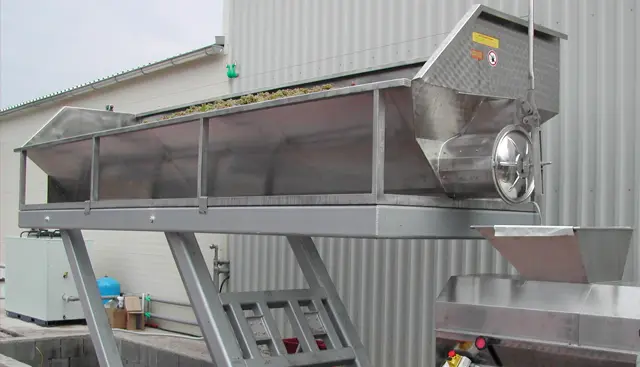
Receiving trough with lifting mechanism
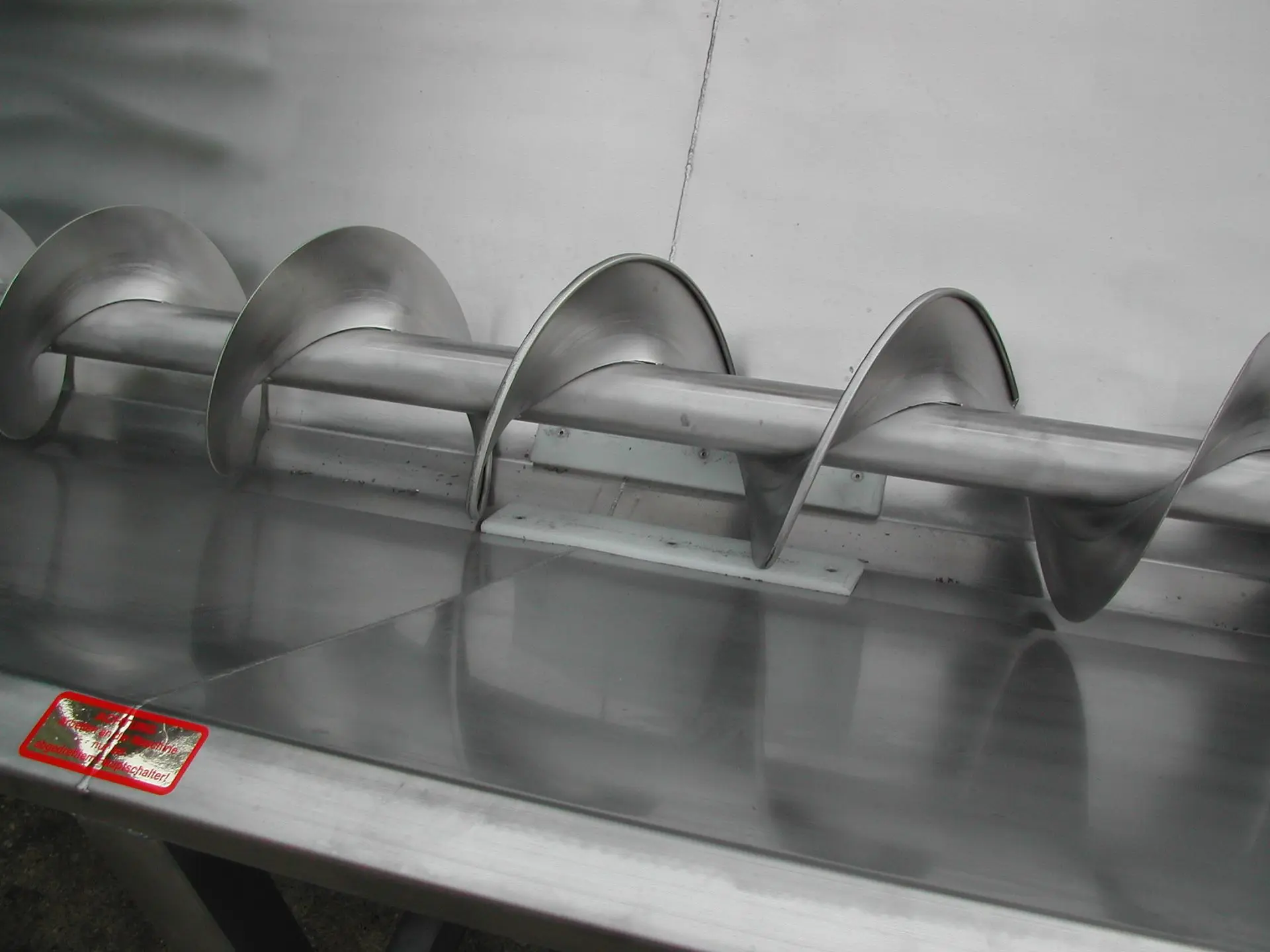
Up to 6 m in length and 350 mm in diameter, as well as custom sizes
Capacity from 1.5 to 12 tonnes
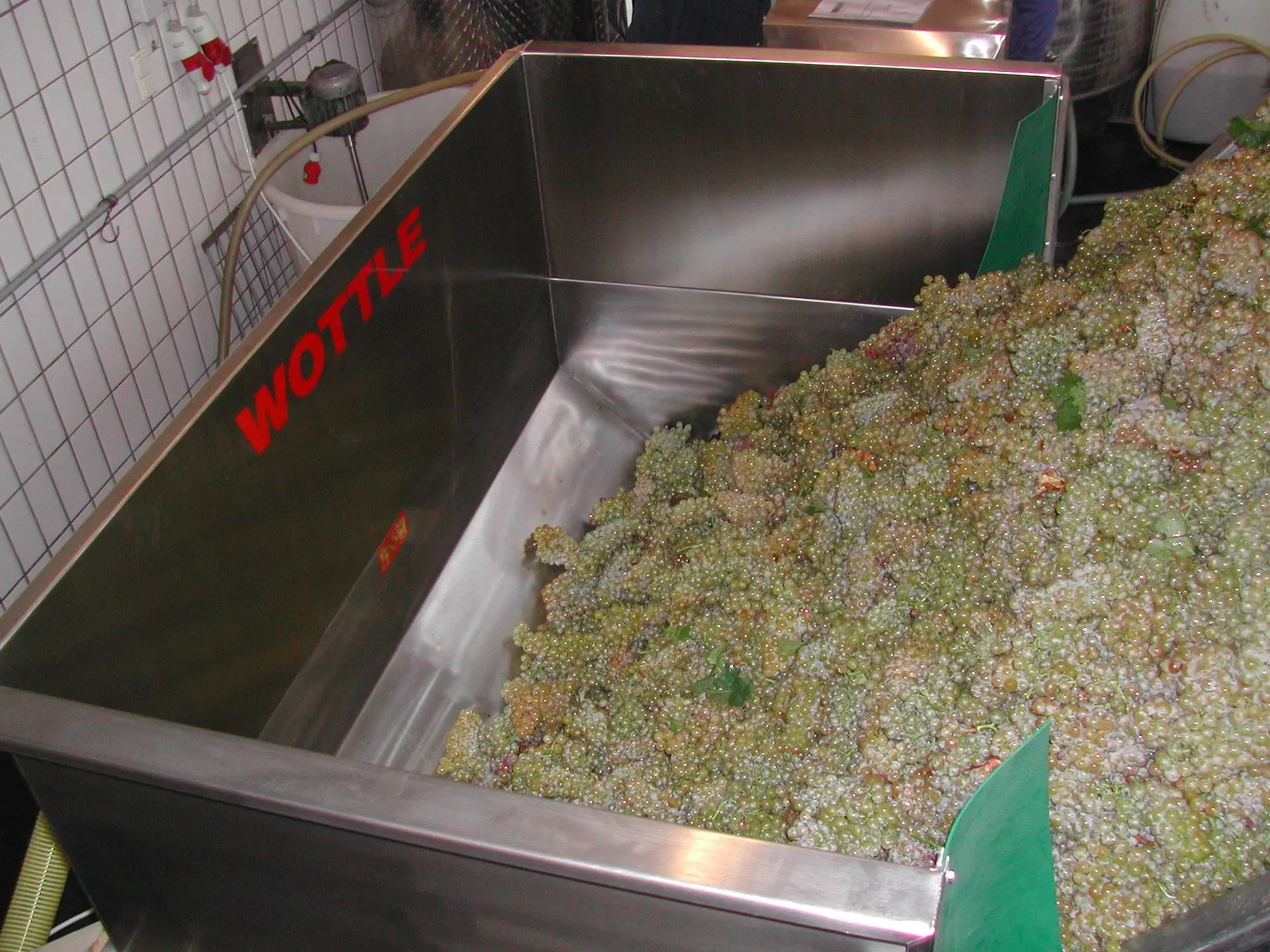
WOTTLE tilting chutes: the ideal solution for smaller quantities of grapes
WOTTLE Kippgossen können ähnlich dem Übernahmetrog in die Verarbeitungsanlage integriert werden (z.B. für den horizontalen Weitertransport in eine Abbeermaschine). Sie können WOTTLE tilting chutes can be integrated into the processing line in a similar way to the transfer trough (e.g. for horizontal conveyance to a destemming machine). However, they can also be used for vertical feeding. auch zur vertikalen Beschickung genutzt werden.
Transferring using a tipping trough: what to look out for
Depending on its dimensions, the tilting chute can function as a (very small) transfer trough – or be used as a hopper for feeding presses, destemming machines, etc. However, its design only allows it to be loaded with boxes (small and large crates) or vats; it is not possible to load it using a tipper lorry.
Why choosing the right screw makes the job much easier
As with the receiving trough, the tilting chute screw is also used to convey the grapes during the processing stage. The required dimensions can be determined on the basis of various factors:
- vertical or horizontal conveyance (in the latter case, the gradient must be taken into account)
- Capacity of the tipping trough (i.e. the volume of grapes to be transported)
- Target quality and characteristics of the grapes to be processed
- Characteristics of downstream machinery (in particular, the quantities that can be processed)
Even in the tilting chute, the grapes should be transported as gently as possible to prevent the excessive formation of tannins. Slow, gentle conveyance requires the conveyor to be of sufficient size. If the diameter is small, the screw must run faster to convey the same quantity of grapes – a larger diameter therefore always results in gentler handling of the grapes. WOTTLE screws for tilting chutes are available in diameters ranging from 180 mm to 300 mm.
The volume of grapes fed into the system must be matched to the processing capacity of the receiving machine. For this reason, WOTTLE tilting chutes are fitted with their own control motor. The rotational speed of this motor can be adjusted mechanically using a rotary control or electronically via the central plant control system in order to regulate the transport volume.
The screw conveyor, which is freely mounted on polyamide belts, offers practical operational benefits: the absence of a mounting plate ensures that the grapes are transported gently and without blockages. Cleaning is also made easier, as the screw conveyor is fully accessible along its entire length.
Further advantages of a WOTTLE tipping gutter
As a general rule, a tilting chute is positioned upstream of another piece of equipment (vibrating table, sorting unit, press, etc.). It is therefore important to adjust the volume of grapes fed through to the capacity of this machine, so that the entire process runs smoothly. However, this volume will also depend, amongst other things, on the grape variety being processed, the time of harvest and, consequently, the condition of the grapes. For this reason, WOTTLE tipping chutes are equipped with their own drive system, which can be adjusted as required (see also above, ‘Adjusting the screw’s rotation speed’).
The standard dimensions are 1,250 mm (length), 1,470 mm (width), 2,012 mm (front height) and 2,177 mm (rear height). WOTTLE tipping chutes can be customised to a great extent to ensure they are perfectly suited to your specific requirements – we’ll be happy to advise you personally on the best solution for you!
In line with WOTTLE’s manufacturing standards, the tipping chutes are also impressively robust, being made from high-quality stainless steel. Frame sections curved outwards, continuous welds and a clean finish ensure maximum reliability even under heavy use.
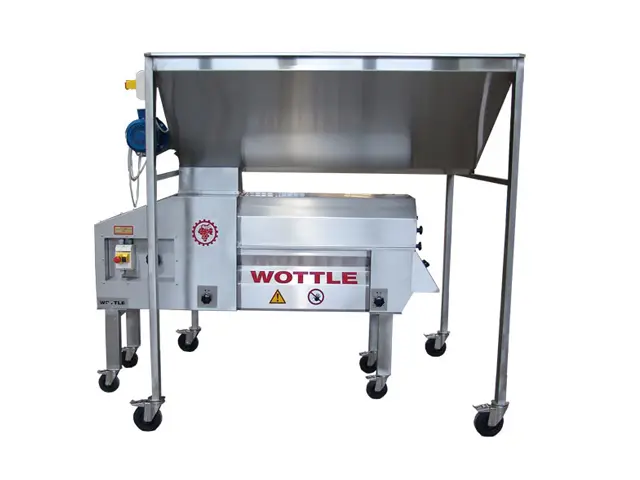
Horizontal or vertical feeding
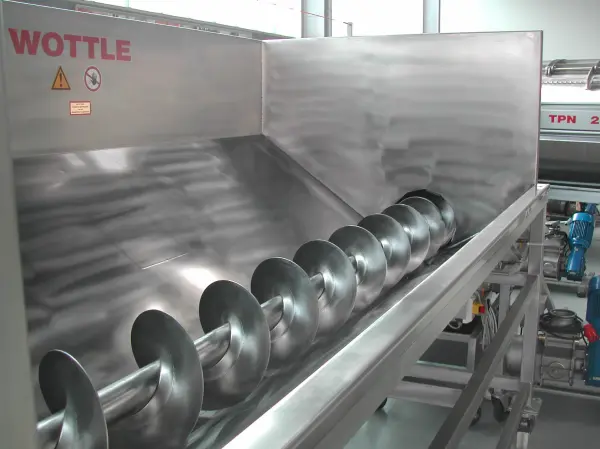
Adjustable screw rotation speed