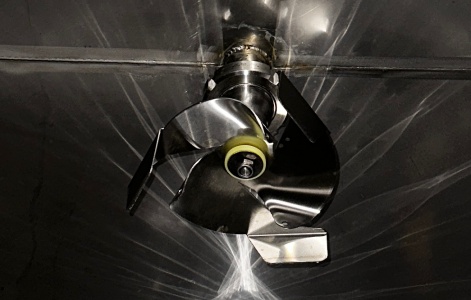
Tank construction: storage tanks and fermentation tanks for the winery
The production of white and red wine places completely different demands on tank construction! That is why, in collaboration with our Croatian production partner, we manufacture bespoke storage and fermentation tanks, fitted with the technical specifications requested by each customer. A range of basic shapes, temperature control options, different grades of steel, base designs, and access and connection types are available.
We therefore equip wineries specialising in red and white wine with the ideal solutions for fermentation and storage tanks. For red wine wineries, a range of technical fermentation control systems is available, along with access to barrique casks, meaning that a wide variety of set-ups can be implemented quickly from a single source.
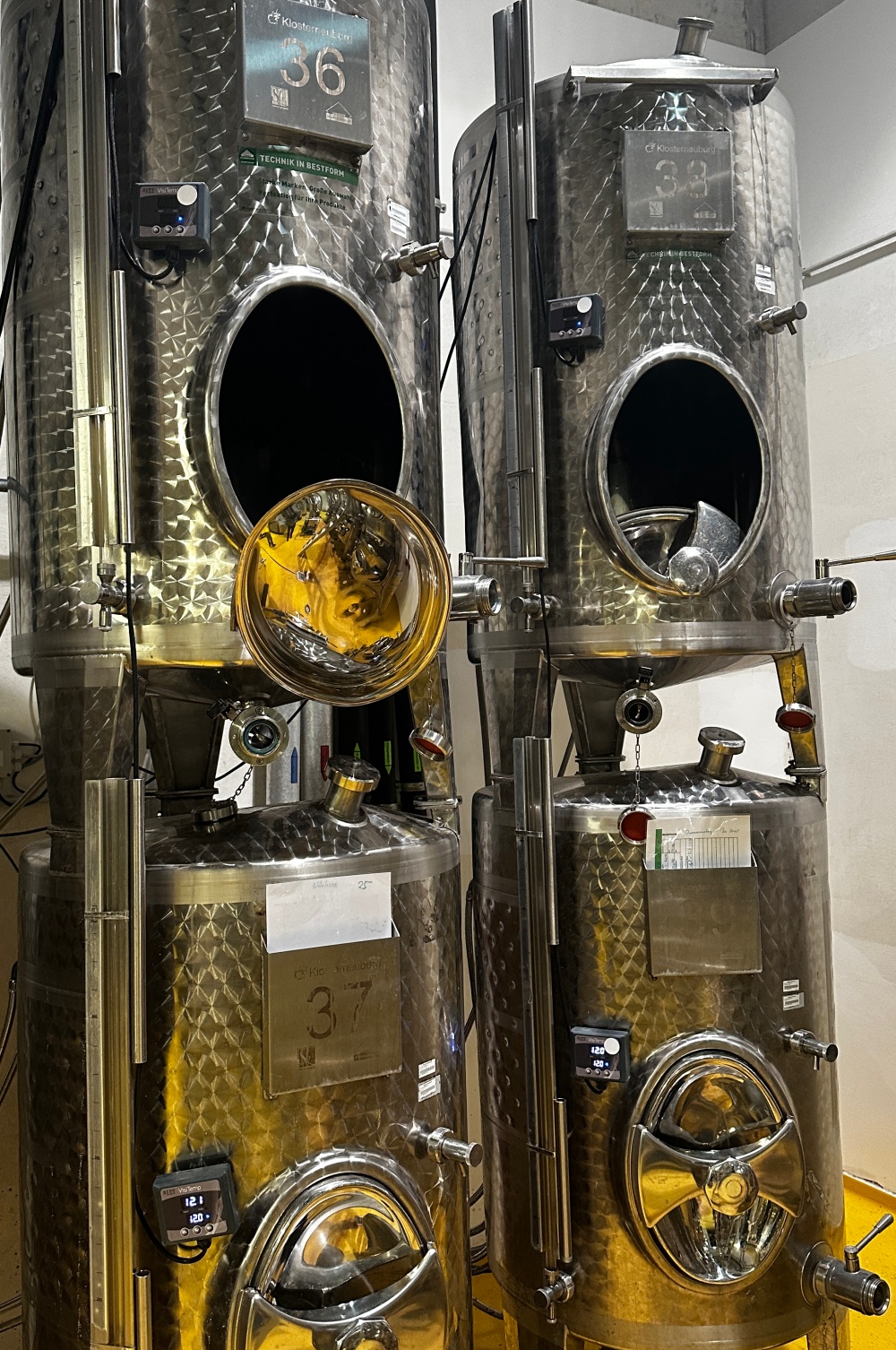
Fermentation and storage tanks for white wine wineries
Based on the area under cultivation, harvest volume or annual white wine production, as well as the varieties and styles produced, we calculate the required number and capacity of the fermentation and storage tanks. Depending on the spatial conditions and the winery’s specific requirements, we develop a suitable geometric and technical solution to ensure efficient and high-quality winemaking processes.
Fermentation and storage tanks for white wine producers
With a wide range of capacities and various technical specifications (such as different ball valves, connections and manhole doors), a variety of steel grades and designs, and well-thought-out solutions tailored to the practical requirements of white wine wineries, we ensure optimal tank solutions for white wine wineries.
Questions about storage and fermentation tanks for white wine wineries
Tank capacity: Our tank solutions for the storage and fermentation of white wines are available with capacities ranging from 500 to 10,200 litres. Standard diameters range from 795 mm (for 500 L) to 2,071 mm (from 6,800 L), and heights from 1 m to 4 m.
Material: An important factor in achieving the ideal tank design is the treatment of the stainless steel used. For example, a 3D surface finish (polished to industry standards) prevents the build-up of unwanted tartar inside the tank. Chrome-nickel steel grade 1.4301 is used as standard. This grade offers particularly good corrosion resistance and strength, and is characterised by good weldability and formability, as well as being food-safe. Grade 1.4301 IIIc refers to a cold-worked
With round and particularly space-saving oval shapes, the available space is utilised to the full. What’s more, with stackable box tanks and even on-site welded built-in tanks, the ideal tank solution can be implemented for any winery!
Always-Full Tank: With this special design, the tank lid is lowered to the current wine level (depending on how full the tank is). The advantage is that the lid, which floats on the liquid, is sealed against the tank wall, thereby preventing oxygen ingress and oxidation. ‘Immervolltank’ tanks are available with a flat base or a conical base (for clean drainage of residual liquid) – with capacities ranging from 50 L to 5,000 L.
Our white wine tanks are ideally suited to fermentation and filtration processes, as well as to storage. For use in non-air-conditioned halls, the tanks can optionally be fitted with a temperature management system for fermentation control, depending on the yeast used or the type of fermentation. The tanks are heated and cooled via a partial double jacket, which can also accelerate fermentation. The width of the double jacket ranges from 2, depending on the tank volume
Temperature control can be adjusted manually directly on the tank. A central control system with a touch panel is used to provide a centralised overview and control of all tanks in the winery. Find out more about the options for fermentation control
The technical tank design can be customised to a large extent. For example, ball valves are available in various versions, ranging from standard models to three-way valves for easier cleaning. Connections and the manhole door can also be positioned according to the expected level of slurry. The residual discharge can also be tailored to any desired processing steps for the slurry. If the addition of treatment agents is required, a dome door is fitted.
Basic model and available trim levels:
- Immersion sleeve, nominal width 15, with analogue thermometer
- Immersion sleeve, 15 mm, for rear fermentation control
- Pipe clamp
- Fuel tank label
- Remaining length of threaded spigot, nominal width 40
- Clearance drain, threaded connection, nominal width 40, with reinforcement ring
- Base and lid pre-assembled
- Stainless steel sampling tap, NW15
- Dome diameter 200 or 300 mm
- Filling nozzle, NW 50 or NW 80
- Oval manhole with reinforcement ring and door, 340 x 440
- Ball valve NW 32-WG 5/4‘; NW 40-WG 5/4’; NW 50-WG 5/4"; NW 80
- Air vent valve, nominal width 50
- Blind cap NW 50, NW 80 or 5
- NW 15 stainless steel level indicator, open at the top with a glass tube
- Enclosed display case, NW 15, or NW 15 at the dome
- Connectors: NW 15, NW 40 (also with reinforcement ring), NW 50 (also with reinforcement ring)
- U-shaped cooling jacket or two-piece cooling jacket
- additional cooling jacket
- Channels on square cooling fins
- adjustable feet
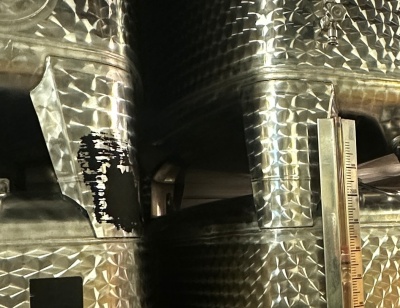
Stackable, space-saving tanks in round and square shapes
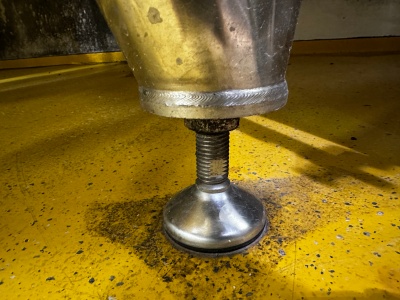
Ideal levelling thanks to height-adjustable feet
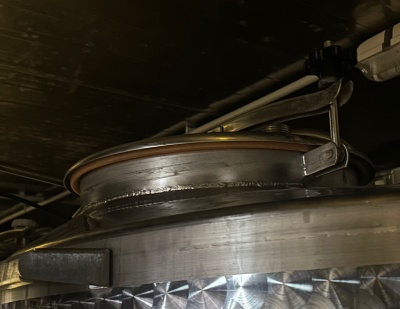
Domtürl is available in 200 or 300 mm
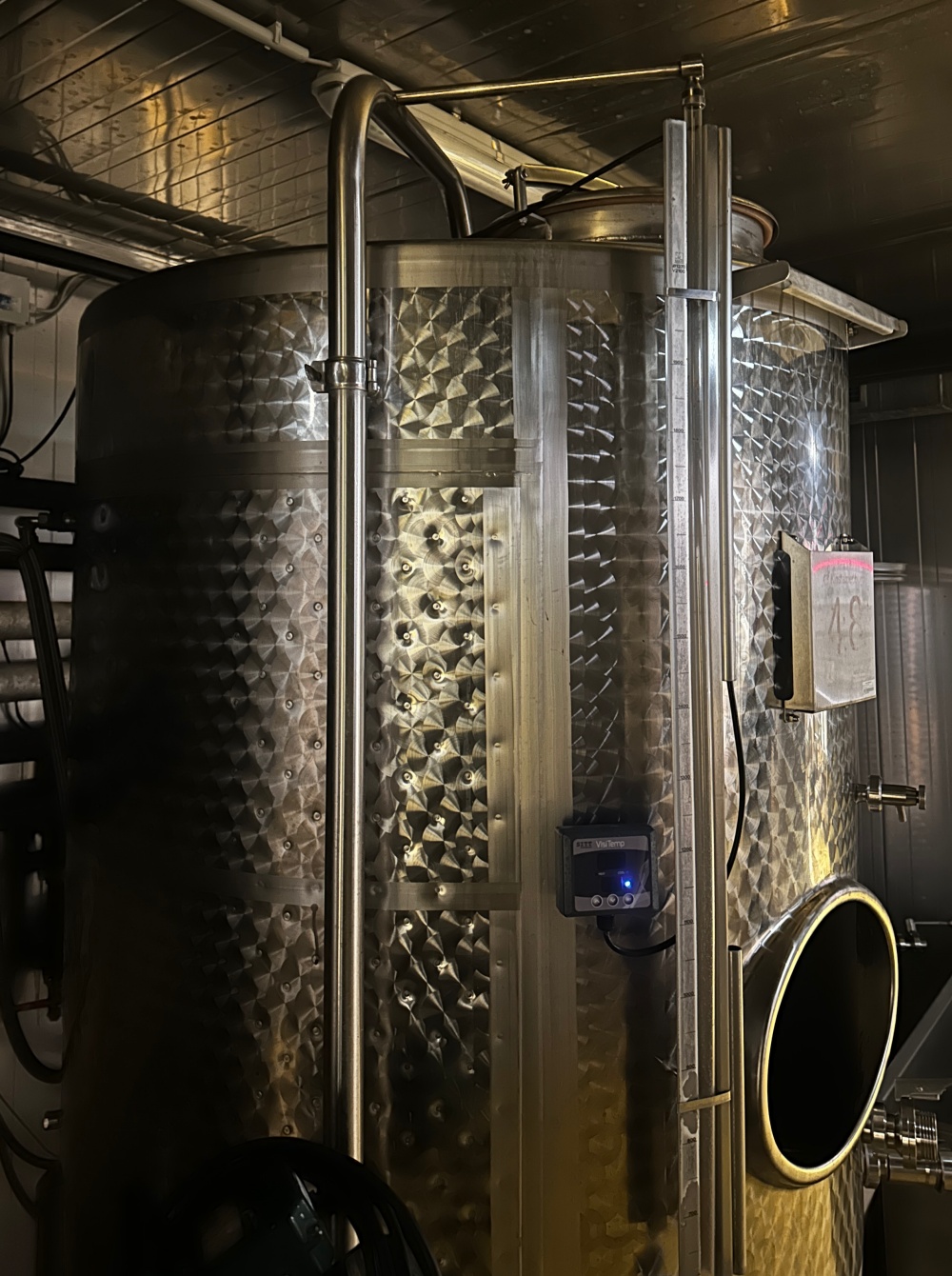
Tank construction for red wine wineries: fermentation and storage tanks
The production of red wine places entirely different demands on the functionality of tanks and vessels. The specific stages of the fermentation process result in different technical requirements. We supply a full range of equipment to meet all requirements – right down to barrique casks.
Fermentation and ageing tanks for red wine production
Unlike in white wine production, the red wine must (the grapes that have been destemmed and crushed during pre-processing) is fermented in the tanks and only then pressed. During this process, the carbon dioxide produced pushes the skins upwards out of the must, forming a ‘cap’ or ‘pomace’. For this reason, a red wine tank must not be filled to more than two-thirds of its capacity to prevent it from overflowing.
In order for the red wine to develop its characteristic colour, the must must be in sufficient contact with these skins – the fermentation tanks must therefore be fitted with appropriate mechanisms for this purpose (unless, as is the case in Burgundy, France, this is done by hand).
Questions about the features of the red wine tanks
Whilst the fermentation duration has little effect on the tannin content, the fermentation temperature plays an important role. Mashed grapes containing tannins are therefore fermented for only a few days, but at high temperatures of over 30°C up to 35°C. This is because the aim is to extract only the soft tannins from the skins.
This requires two technical devices in the tank: firstly, a temperature management or fermentation control system, which in the case of red wine is primarily used for heating (via cooling and heating coils, temperature spirals, plates or a double jacket); and secondly, a device that keeps the must in contact with the cap or lees (except when producing rosé wine).
In the past, agitation tanks were used for this task, in which the must was stirred by an agitator that extended over the entire height of the tank (or, in the case of horizontal tanks, its length). Due to the high sediment content and dominant bitter compounds in the pulpy mass, other systems are now preferred: in so-called overflow tanks, the wine is drawn off from the bottom, pumped upwards into a fixed or rotating spray head, and from there trickles down onto the cap of pomace. As it passes through, it releases
This sprinkling can be combined with aeration: in this process, air is released in a controlled manner via air lances fitted inside the tank; it rises upwards and breaks up the cap of pomace from below. Such a system can also be operated without sprinkling.
Another alternative available from WOTTLE is the hydraulic plunger or submersion technique: in this process, the cap of pomace or cake is submerged using a device (‘mash breaker’) that extends from the top down to the bottom third of the tank, so that the fermenting must extracts the colouring compounds from the grapes. However, this technique involves relatively high costs.
Once the fermentation process is complete, the top 20 per cent of the tank’s height is filled with the cap of pomace or the lees. Below this lies the fully fermented red wine, which is pumped via a clear-off outlet and, for example, an impeller pump into the designated storage tank or even a wooden cask. As the wine is drained off, the cake sinks onto the remaining skins, dead yeast and fruit pulp at the bottom (which, once fermentation has ended, sinks due to the loss of buoyancy caused by the absence of CO₂ production).
To remove this residual mash from the tank, a positive displacement pump can be used, for example, to gently transfer the cake into the wine press. Special tanks with sloping bases further facilitate the removal of the residual mash: the inner tank base is constructed with a gradient of 5 per cent to 45 degrees towards the drain (the opening at the bottom of the tank), allowing the residual mash to flow out of the tank.
In principle, all tanks can be manufactured in various basic shapes (round, oval, rectangular) or in a conical shape (wider at the bottom than at the top). It is also possible to design them as stackable tanks, split tanks, built-in tanks, tanks with sloping bases with a customised gradient, etc.
Here is an overview of our tanks – further sizes/dimensions available on request!
Storage tanks (vertical or horizontal):
Stainless steel sheet, material grade 1.4301, IIIc, with feet permanently welded to the tank; round pattern; oval manhole door; 5/4” ball valve for clear liquid outlet; 5/4” residual liquid outlet; blind cap; drainable sight glass and sample tap; NW50 filling nozzle; on request: 3D polished interior
Available from 1,000 litres to 40,000 litres
diameter: 920 bis 3.000 mm
height (incl. feet): 2.050 bis 6.200 mm
Immervolltanks Standard:
Stainless steel sheet, material no. 1.4301, IIIc, feet, flat base, stainless steel drain valve ¾” (up to 300 L ½” pipe), floating lid with air hose, stainless steel air pump with pressure gauge, dust cover; on request: 3D polished interior
available from 50 L bis 2.000 litres
diameter: 400 bis 1.274 mm
height (incl. feet): 690 bis 2.150 mm
Immervolltanks conical base:
Stainless steel sheet, material no. 1.4301, IIIc, feet, conical base, clear-out drain ¾”, residual drain 5/4”, tap 3/8”, floating cover with air hose, stainless steel air pump with pressure gauge, dust cover; from 2000 litres: Handle for operating the floating lid; on request: 3D polished interior
available from 500 l bis 5.000 litres
diameter: 800 bis 1.752 mm
height (incl. feet): 1350 bis 2.650 mm
Overflow tanks:
Stainless steel sheet, material no. 1.4301, IIIc, round plate design, with feet permanently welded on, rectangular door, 5/4” ball valve for clear drainage, 2” blind cap for residual drainage, drainable stand glass and tap
available from 3.000 l bis 15.000 litres
diameter: 1.200 bis 2.500 mm
coat height: 1.250 bis 3.000 mm
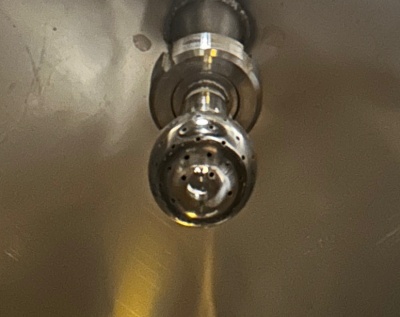
A spray nozzle inside the tank to spray the cap of pomace, so that the wine takes on colour
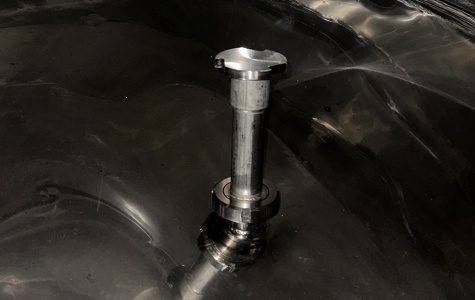
An air lance fitted to the bottom of the tank to break up the pomace cap from below